Tattoo Stencils Through the Years: How Artists Solved the Same Problem Over and Over
Tattoo stencil application has always been about solving one problem: how to get a clear guide on skin that stays put long enough to tattoo without smearing, sliding, or wiping away too easily. The tools changed, but the problem stayed the same.
What follows isn’t marketing history. It’s how working tattooers actually adapted, step by step.
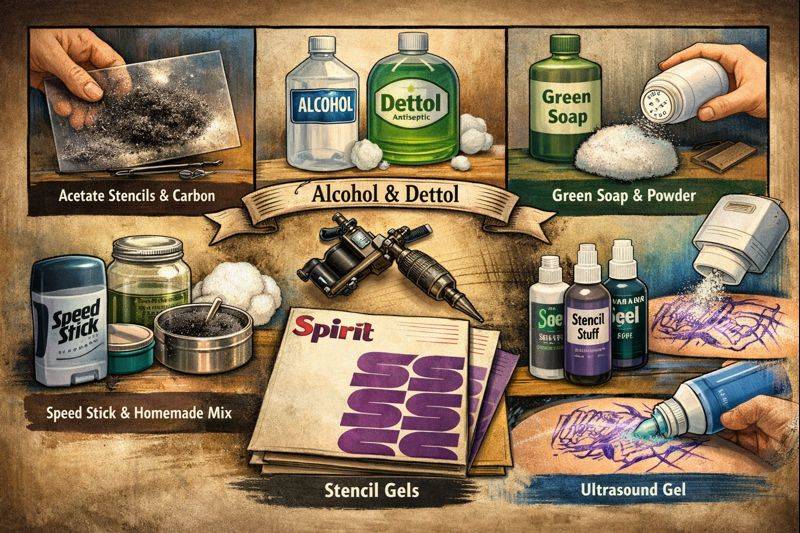
The Beginning: Acetate Stencils and Carbon
Before spirit paper, many tattooers used clear acetate or celluloid stencils. Designs were hand-scribed into the plastic using a needle or blade.
The transfer process was simple:
A light coat of Vaseline on the skin.
Carbon powder, charcoal, or lampblack dusted over the stencil.
Press the stencil to the skin and lift it away.
This method didn’t fade. It wiped off easily because the carbon was only held in place by petroleum jelly. That was understood and accepted.
The advantage was control:
The stencil was transparent, so placement was exact.
If it wiped off or needed adjustment, you just reapplied carbon to the stencil and put it back down.
No waiting for anything to dry. No commitment beyond your own confidence.
It relied on mechanical grip, not chemistry.
Alcohol and Antiseptic Prep
As tattooing moved toward cleaner, more standardized practices, some artists began using alcohol alone or antiseptic soaps like Dettol for stencil transfer.
Alcohol worked by:
Removing surface oils.
Tightening the skin slightly.
Creating a clean surface for stencil dye.
Artists like Cindy Ray referenced alcohol and antiseptic soaps in early instructional material. These methods helped stencil dye stick temporarily, but they didn’t truly solve smearing. Alcohol prepped the skin. It didn’t provide adhesion.
Green Soap and Managing Smear
When green soap became common for stencil transfer, it solved multiple problems at once:
Cleaned and disinfected.
Degreased without over-drying.
Left a light glycerin residue when wiped thin.
That residue gave stencil dye something to grab onto, but it introduced a familiar issue. If you worked too soon, the stencil could smear or ghost.
Tattooers adapted with technique.
A common solution was baby powder:
After transfer, a light dusting was applied.
Excess was blown or brushed off.
The powder absorbed surface moisture and helped set the stencil faster without having to wait. This wasn’t a product innovation. It was experience filling in the gaps.
Speed Stick: Faster Set, Harder Grab
Then came Speed Stick deodorant, discovered not because it was meant for tattooing, but because it worked.
Speed Stick contains:
Alcohol for prep.
Propylene glycol and glycerin.
Waxes and polymers that become tacky after evaporation.
Compared to green soap, Speed Stick:
Set faster.
Grabbed harder.
Reduced smearing once flashed off.
Artists still used baby powder when needed, but the overall process sped up. The stencil stayed darker longer and resisted wiping better.
The Homemade Stencil Slurry Era
This is the part that gets skipped in most histories.
Tattooers didn’t stop at straight Speed Stick.
They started melting Speed Stick and adding hand sanitizer, just enough to change its behavior. The goal was specific:
Keep the tack.
Prevent it from drying back into a hard solid.
Create a semi-solid, gel-like consistency.
Hand sanitizer worked because it added:
Alcohol for flash-off.
Additional humectants.
A controlled evaporation rate.
The result was an almost-solid paste that stayed spreadable and tacky without re-hardening. It applied thinner, set more predictably, and held stencils without excessive smearing.
This was the real transition point.
From Homemade to Bottled
That Speed Stick and hand sanitizer mixture directly led to commercial stencil products.
Manufacturers didn’t invent a new idea. They standardized it.
Most ready-made stencil solutions are built on the same concept:
Humectants like glycerin or propylene glycol.
Polymers and gums for tack.
Controlled drying time.
They’re essentially refined, shelf-stable versions of what tattooers were already making on their own.
Ultrasound Gel: Same Physics, New Container
More recently, some artists have turned to ultrasound gel, a medical product designed for imaging equipment.
It works because it’s:
Water-based and oil-free.
High in humectants.
Thickened with polymers that stay tacky.
Used thin, it transfers stencils well. Used heavy, it slides. Many artists still dust lightly with powder to speed set time.
Same problem. Same fixes.
Why Green Soap Still Holds Its Ground
With everything available today, green soap still makes sense because it balances all the variables:
Cleans and preps.
Transfers reliably.
Doesn’t over-stick.
Fades predictably.
Requires no extra products if used correctly.
And if speed matters, the old baby powder trick still works.
What Never Changed
No matter the era or product, stencil success always comes down to:
Clean skin.
Thin application.
Controlled moisture.
Proper pressure.
Knowing when it’s set.
Carbon and Vaseline.
Alcohol.
Green soap.
Speed Stick.
Homemade slurry.
Bottled gel.
Ultrasound gel.
Different tools. Same physics.
The hand still matters more than the bottle.